Mystery Science Radio was a shortwave pirate station that was inspired by the television series Mystery Science Theater 3000 (known as MST3K) which was broadcast for a total of 11 years on American television. MST3K started at a small UHF station KTMA in Minnesota and was quickly picked up by Comedy Central, then finally the Sci-Fi Channel for its last three years. Mystery Science Radio appeared in late 2000, broadcasting tributes to Andy Kaufman, Monty Python and the Holy Grail, and a whole program devoted to Theremin music.
MST3K involved Joel (and later, Mike) trapped in space by mad scientists (Dr. Clayton Forester and TV’s Frank) on the Satellite of Love with robot puppets Tom Servo, Crow, Gypsy and Cambot. Each week they were forced to endure horrible B movies and the show revolved around their satirical and hysterical commentary while watching the movies. Typical films shown were Japanese monster flicks such as The Creeping Terror, or movies like The Amazing Colossal Man or The Atomic Brain. Between movie segments audiences were treated to comedy sketches with Joel (or Mike) and the bots. Many of the sketches were themed around the week’s movie. Sometimes they’d even break into a song such as Slow the Plot Down sung as a sea shanty with Joel and the bots dressed as pirates.
In the early transmissions of Mystery Science Radio, the lone host was Cherokee Jack Perkins. Cherokee Jack claimed to be broadcasting from the Yellow Submarine where he was somehow forced to listen to really bad radio shows. Later episodes included Cherokee Jack’s sidekick Torgo (a character from MST3K cult favorite Manos, Hands of Fate). Torgo had a wavering voice and loved bizarre records like Music for a Pack of Hungry Cannibals. According to Cherokee Jack, the December 2002 transmission of Mystery Science Radio was the final broadcast, however the station then evolved into Theremin Radio which was heard once on shortwave frequencies during 2003.
Cherokee Jack once said, when asked if he’d be returning to the airwaves, “I never say never, except just then.”
Here's a link to an archived Mystery Science Radio from 2002:
http://www.mediafire.com/?ssczqng4g2z1sx1

Welcome to the Paper Radio blog, an online presence for my print zine ... Paper Radio is about shortwave listening, free radio, community radio, DIY media and evolves from there. Most issues are compilations of articles written by myself & others, a freeform reading experience to celebrate freeform radio. Enjoy ~


4/29/08
A Long Overdue Update
Yes ... I'm still alive! And yes, I *do* have plans for another issue of "the /wave project: Signals" sometime in 2008. I have been depressed about the zine for the past six months because microcosm, which has become the Amazon of zine distributors, declined to stock / distribute the previous issue because it was too 'thin' (20 pages.) I have seen distros sell zines that are only several pages long or even one sheet of paper folded but apparently for some reason Signals didn't have the substance they were looking for. No distribution = no readership. No readership = no motivation to publish. It is time consuming enough writing, editing, soliciting submissions, etc. Hunting for distributors is just more work in my already full schedule.
The /wave project: Signals is not dead, just hybernating until the right elements combine to create the next issue. It will continue to focus on indie media including shortwave, pirate and low power fm radio as well as other media topics. New topics this year may include amateur radio and creating community libraries.
Long live free radio and free speech. Contributions of articles and letters for the next issue are welcomed at singinggrove@conknet.com.
Peace ~
DJ Frederick
The /wave project: Signals is not dead, just hybernating until the right elements combine to create the next issue. It will continue to focus on indie media including shortwave, pirate and low power fm radio as well as other media topics. New topics this year may include amateur radio and creating community libraries.
Long live free radio and free speech. Contributions of articles and letters for the next issue are welcomed at singinggrove@conknet.com.
Peace ~
DJ Frederick
8/25/07
New issue - SIGNALS No. 2

It's been a few months since SIGNALS No. 1 was published and it is now essentially out of print - the last remaining copies are available at www.microcosmpublishing.com.
SIGNALS No.2 has been printed in a small run of 45 copies. This issue includes an article on WUMS the legendary medium wave & shortwave "outlaw" station and great short fiction piece by Michael G. McLaughlin titled "The Death of Rock & Roll".
This installment of /the wave project is slim but (I hope) filled with quality content related to indie media & free radio. Thanks to the postal service which loves Time Warner & hates DIY and small press publishers, the cost of this issue is $2.50 postpaid.
Copies may be ordered through PayPal via singinggrove@conknet.com
Thank you for supporting this homegrown effort - my intention is to continue publishing /the wave project print zines every 4 to 6 months as long as I have a few bucks left on my credit line. Your feedback is much encouraged and appreciated.
6/21/07
Regarding Postal Increases
Dear Mr. Hodes,
In response to your response, I want to point out that there is not a non-profit periodical 'industry' per se. There are small "labor of love" or community based publications operating on a shoestring budget and published individuals or small groups of people who are seriously affected by these rate increases. The impact of postal increases on these publications is enormous, and indirectly creates an impact upon freedom of the press, free speech, and the ability to enjoy and participate in our representative democracy. In a world where media is controlled by a handful of corporations, the survival of small publications is more important than ever.
Sincerely,
Frederick Moe
****************
Dear Frederick,
Thank you for contacting me about your concerns about the recent postal rate increases. I appreciate that you took the time to share your thoughts with me.
The United States Postal Services (USPS) increased postage rates effective May 14, 2007. The USPS's Board of Governors raised the price for first class mail to $0.41. The Board of Governors increased the rates to all types of mail, except for periodicals, whose rates will be changed in mid July.
The USPS is increasing prices to keep up with its operating costs. I expressed concern to the Board of Governors of the USPS in one instance where I thought the increase was excessive-the up to 36% rate increase for the catalog and non-profit periodical industry.
I will continue to follow the rate increases to make sure that they are reasonable and not too severe. It is important that the USPS prices allow mailing services to be accessible to all Americans.
Thank you again for sharing your thoughts with me. If you would like information on this or any other issue, visit my website at http://hodes.house.gov. Please do not hesitate to contact me in the future to express your views or if I can be of help on any matter.
Sincerely,
Paul Hodes
Member of Congress
In response to your response, I want to point out that there is not a non-profit periodical 'industry' per se. There are small "labor of love" or community based publications operating on a shoestring budget and published individuals or small groups of people who are seriously affected by these rate increases. The impact of postal increases on these publications is enormous, and indirectly creates an impact upon freedom of the press, free speech, and the ability to enjoy and participate in our representative democracy. In a world where media is controlled by a handful of corporations, the survival of small publications is more important than ever.
Sincerely,
Frederick Moe
****************
Dear Frederick,
Thank you for contacting me about your concerns about the recent postal rate increases. I appreciate that you took the time to share your thoughts with me.
The United States Postal Services (USPS) increased postage rates effective May 14, 2007. The USPS's Board of Governors raised the price for first class mail to $0.41. The Board of Governors increased the rates to all types of mail, except for periodicals, whose rates will be changed in mid July.
The USPS is increasing prices to keep up with its operating costs. I expressed concern to the Board of Governors of the USPS in one instance where I thought the increase was excessive-the up to 36% rate increase for the catalog and non-profit periodical industry.
I will continue to follow the rate increases to make sure that they are reasonable and not too severe. It is important that the USPS prices allow mailing services to be accessible to all Americans.
Thank you again for sharing your thoughts with me. If you would like information on this or any other issue, visit my website at http://hodes.house.gov. Please do not hesitate to contact me in the future to express your views or if I can be of help on any matter.
Sincerely,
Paul Hodes
Member of Congress
5/25/07
Uncle Enos Zine Review

The most intriguing zines are infused with passion : in the writing, subject matter, layout, design and energy. Uncle Enos exudes passion from cover to back page, passion for music and life. Since its arrival in my mailbox, I have been immersed in reading the fascinating articles within.
The cover of Uncle Enos announces "the lo-fi voice of the Prim Rock underground". Uncle Enos is full of information related to DIY music, cigar box guitars & related instruments, recordings, forgotten heroes, building projects, artwork. I was thrilled to find an artcile about the creation of the Trees Community box set. Ecstatic to learn about Willie Joe Duncan and wondering how I can hear the Unitar. Mesmerized by Timothy Renner's artwork.
Reading zines should be an experience of discovery. Every page of Uncle Enos was a discovery for me. Thank you, Shane, for taking it deep & creating this incredible first (and hopefully not last) issue.
For more on Uncle Enos info contact cigarboxguitar@yahoo.com
5/20/07
New issue!!!!

Hot off the copy machine - the new issue of the /wave project entitled SIGNALS!
This installment includes a lengthy interview with John Poet of the Crystal Ship, an update from Doctor Benway of Undercover Radio, a letter from zinester James N. Dawson & more. $3.25 postpaid (yes its higher ... thank you USPS)
first print run = 30 copies.
12/19/06
Uneasy Listening
Uneasy Listening
One of the things that corporate media owners count on from consumers is that people will watch or listen to whatever is put in front of them. How many workplaces have the same bland “oldies” or middle of the road pop station playing on the radio, with innocuous tunes sprinkled between incessant commercials & DJ’s pressured “blah blah blah”. How many homes have the television on in the background, almost 24/7? Five thousand channels and nothing on except distractions.
Media is not meant to be passively absorbed like the oxygen around us. Ideally, we need to use critical thinking skills when engaged with reading, radio, listening to music or watching the glowing screens of television or computers. One of the frustrations of shortwave listening for some people is that compared to what we’re used to in the technology age, it requires work and research – knowing what stations are broadcasting to North America, on what frequencies, and what times. It is a more active approach to radio listening than people are used to. Then there are the issues of reception, antenna placement, and signal propagation. Yet this effort is well worth the payoff – hearing stations that you will not hear elsewhere, some of which do not broadcast even on the internet.
The majority of radio stations in the US fall into one of the following categories: Commercial Rock, Country or Oldies, Commercial Talk Stations (mostly conservative politics) or Christian stations. Is this reflective of our country as a whole? Or simply corporate profit-driven formats? Intriguing how there are so many talk shows and so little dialogue or listening happening & how there are so many so-called Christian stations and few or no Judaic, Muslim, Pagan, or Atheist stations.
If your community is not well represented by any of the above formats, what to do? Listen to public radio? Public Radio is an improvement, yet much of it isn’t truly ‘public’ radio – it’s Public Funded Radio. Granted there are some fantastic programs available via Public Radio that are not broadcast elsewhere. If you’re very lucky, you might live within signal range of college radio stations, Low Power FM stations, non-commercial community supported radio stations or possibly unlicensed “pirate” stations. You’ll know the pirate stations because they may be playing music with a lot of swearing, or the DJ’s may be swearing, or they may never give an ID, or they may be playing programs and having discussions or spinning music that are intriguing and you’ve never heard anything like it before. Urban areas generally have many more listening opportunities and choice than rural areas. The key is to do some research and kind out what’s happening on your local radio dial. In some areas there are also low power or community stations on the AM bands as well. I suggest listening with a radio that has a decent antenna, and if your radio doesn’t, you can buy am or fm antennas cheap at electronics stores. A good antenna will pull in more distant stations, or those with weaker signals like Low Power stations.
Radio is meant to be interactive. So call stations, e-mail, write, communicate with them and give them feedback on what you’re hearing. If they are not serving your community appropriately, tell them! If they’re doing cool things, let them know! Don’t let some faceless corporate boss decide what you should listen to. Consider creating your own radio show where there are needs that aren’t being met for information, music or creative energy. Community and college stations are often very open to new volunteer DJs and program producers. Turn on your friends to good stuff you’ve heard on the airwaves. Turn off the TV or better yet, hook up an old antenna & find out if there are any UHF pirates broadcasting in your area – pirate television is also alive, though with fewer broadcasts.
So it’s no more easy listening for people who want to create change in their lives or in the community. Tune out the garbage and tune into the voices in your neighborhood or community. Explore the radio spectrum and all it has to offer, and if it’s not offering what you need or want, create it! Podcasts are great as well, but the magic of radio is that it reaches a potentially wider audience, and a computer or Ipod/mp3 player isn’t required.
10/15/06
RADIO/waves review in Utne
Utne Magazine Review August 2006
DJ Frederick's zine, the /wave project is devoted to shortwave and pirate radio. The third issue, "RADIO/waves," covers pirate (a.k.a., "free") radio from technical instruction -- "Single Side Band" and "How to hear your first pirate" -- to personal experiences with the medium. Also included are interviews with the likes of Alan Maxwell, a sub-cultural hero. DJ Frederick's veneration for this elusive mode of contact emanates from the page, drawing any reader in, pirate radio fan or otherwise. Even tech-speak has a tendency to become poetic through his words, as in his explanation of propagation: "Shortwave radio signals are capable of reaching the other side of the planet because they can be refracted by the ionosphere." -- Suzanne Lindgren
DJ Frederick's zine, the /wave project is devoted to shortwave and pirate radio. The third issue, "RADIO/waves," covers pirate (a.k.a., "free") radio from technical instruction -- "Single Side Band" and "How to hear your first pirate" -- to personal experiences with the medium. Also included are interviews with the likes of Alan Maxwell, a sub-cultural hero. DJ Frederick's veneration for this elusive mode of contact emanates from the page, drawing any reader in, pirate radio fan or otherwise. Even tech-speak has a tendency to become poetic through his words, as in his explanation of propagation: "Shortwave radio signals are capable of reaching the other side of the planet because they can be refracted by the ionosphere." -- Suzanne Lindgren
8/6/06
The /wave project issue 3 available

RADIO/waves, the third issue of the /wave project has been published. This issue includes an interview with master storyteller and broadcaster Alan Maxwell, and insights on shortwave pirate radio listening from John Sedlacek. 28 pages. $3 cash postpaid from Color Wheel 36 West Main Street Warner NH 03278.
1/20/06
AIR/waves zine now available
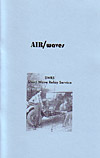
The second issue of the /wave project written by DJ Frederick is now available! Includes a related CD!
In this issue:
Pirate Station profiles
The Voice of Laryngitis
3 stations to listen for
Radio For Peace International
writing reception reports
... and more!
available from www.atomicbooks.com (do a search for AIR/waves).
Subscribe to:
Posts (Atom)